I’ve been testing StealthWriter AI for content creation and I’m not sure if it’s actually worth relying on long term. Some outputs look great, but others feel generic or risky for SEO and originality. Can anyone who’s used StealthWriter AI share real-world pros, cons, and whether it’s safe and effective for blogging and online business content?
StealthWriter AI review, after using it for a week
StealthWriter AI: StealthWriter AI Review with AI-Detection Proof - Best AI Humanizer Reviews

I went into StealthWriter AI with some hope because of the price. It sits around 20 to 50 dollars per month depending on the plan, so I expected something cleaner than the usual auto-rewrite tools.
What pulled me in:
- Two engines: Ghost Mini and Ghost Pro
- Intensity slider from 1 to 10
- A bunch of style presets
- Free tier with limits
On paper it looks like someone tried to do more than a basic paraphraser. In practice, it felt half-finished.
Detection tests I ran
My use case was simple. I had some AI generated text that I wanted to run through humanizers and see how far they get past public AI detectors.
Detectors I used:
- ZeroGPT
- GPTZero
I pushed the same source text into StealthWriter AI with different settings and logged the results.
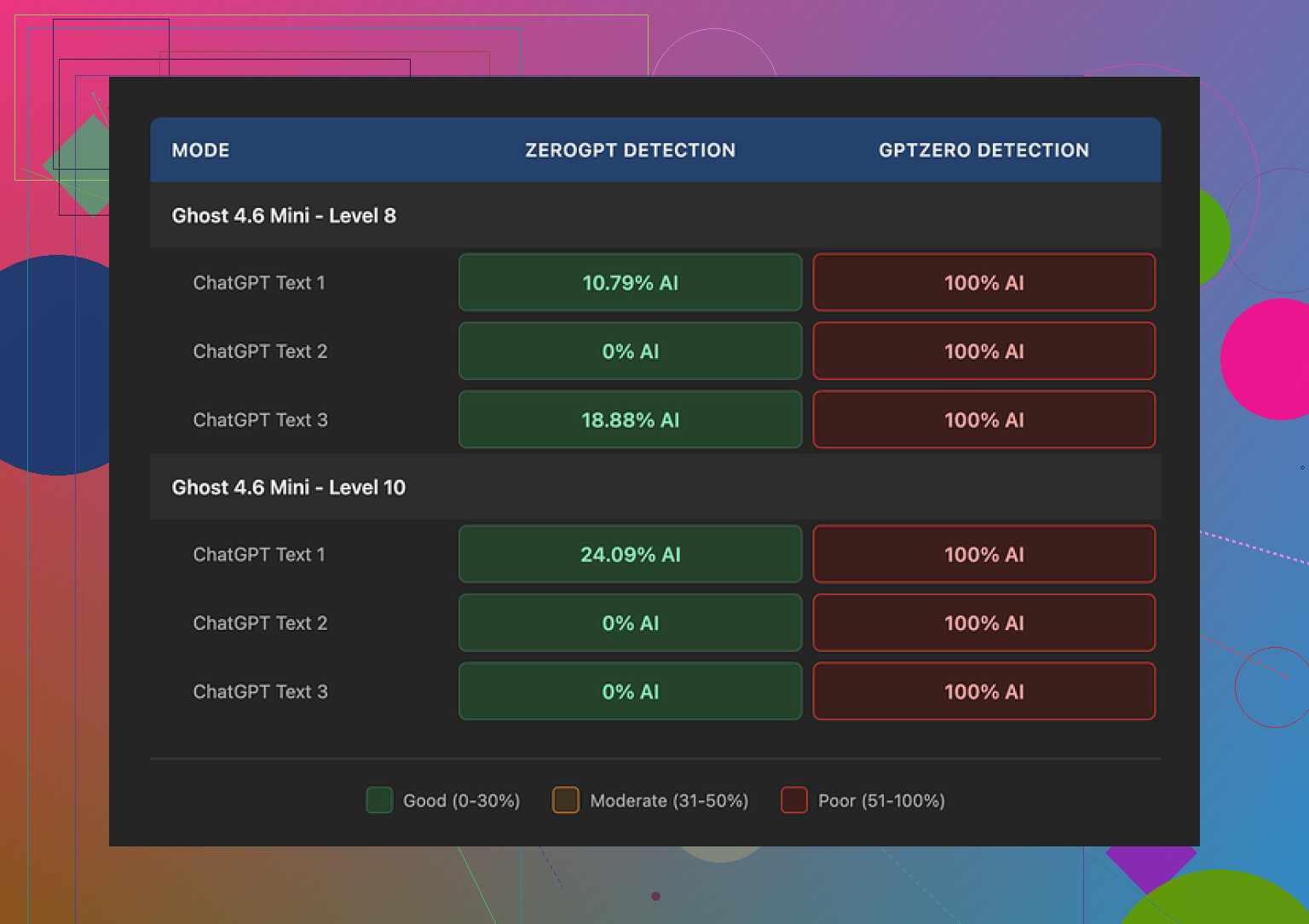
ZeroGPT:
- At intensity Level 8, a few outputs passed with low scores
- I saw readings as low as 0 percent and around 10.79 percent AI on some samples
So ZeroGPT liked it at Level 8. That looked good at first.
GPTZero:
- Different story
- Every single output got flagged as 100 percent AI
- Did not matter if I used Ghost Mini or Ghost Pro
- Did not matter if I set the intensity to 4, 8, or 10
So for GPTZero, the settings felt fake. It behaved as if I pasted raw AI text.
What happens when you push intensity higher
I tried intensity Levels 6, 8, and 10 with the same base paragraph, mostly on explanatory content like climate science.
My rough quality scores, as a human reading it:
-
Intensity 8
- Around 7 out of 10
- Mostly readable
- Some weird phrasing and missing small words
- Felt like a non-native speaker who writes decent English but hurries
-
Intensity 10
- Drops to around 6.5 out of 10
- Random expressions pop in that do not fit the text
- I saw phrases like “god knows” slapped in the middle of a climate science passage
- Grammar issues started showing up, for example:
- “Coastlines areas” instead of “coastal areas” or “coastline areas”
- “feeling quite more frequent flooding” instead of something like “experiencing more frequent flooding”
So turning intensity to the max did not “humanize” much. It mutated the text and made it easier to spot as off.
Stuff it does decently
One thing I did notice. StealthWriter AI keeps the length of the original text almost the same.
A lot of other humanizers pad content:
- Add filler sentences
- Stretch every idea
- Turn a 1,000 word piece into 1,400 or 1,500 words
StealthWriter tends to keep the word count aligned. For people who need to match an original structure or keep a document tight, that is a plus.
Free tier details from my use:
- You get around 10 humanizations per day
- Up to about 1,000 words each
- You need an account
- Ghost Pro sits behind paid plans, so on free you are mostly testing the lighter version
For low volume use and quick experiments, the free plan was enough for me to see how it behaves.
How it compares to another tool
During the same testing session I tried another tool: Clever AI Humanizer.
Same content, same detectors, same environment:
- Clever AI Humanizer outputs read more natural to me
- Less awkward phrasing
- Fewer grammar mistakes
- It passed detection as well or better on the samples I tried
- It did not cost me anything
So if you are deciding where to spend money, my experience leans away from StealthWriter AI right now, at least if your priority is surviving GPTZero type checks without wrecking the text quality.
If you only care about ZeroGPT and want to preserve text length and have some style presets to play with, StealthWriter AI works to a point, but the cost feels high for what you get.
1 Like
I’ve been testing StealthWriter too and had a similar mixed experience, but I’d look at it a bit differently than @mikeappsreviewer.
Short version
• For long‑term content work, I would not rely on it alone.
• For light rewrites where you stay in control, it is usable.
• For SEO and originality, you need a stronger workflow around it.
Here is how I’d break it down.
-
Content quality and “generic feel”
If you feed it generic AI text, you usually get more generic text out.
What helped me a bit:
• Shorter chunks, under 400–500 words.
• Use a lower or mid intensity instead of cranking it to 10.
• Rewrite your headings and intros yourself.
Headlines and first paragraphs set the “voice”. If those feel bland, the whole article feels bland, even if the body is ok. -
SEO and originality risk
Main issues I saw:
• Phrases repeat across outputs.
• It keeps structure too close to the source.
That is risky for both SEO and originality.
To reduce that risk:
• Change the outline manually.
• Add unique examples, data points, or opinions that come from you.
• Run important posts through plagiarism checks, not only AI detectors. -
Detector focus
You mentioned SEO and originality, not only “passing AI checks”.
Chasing detector scores alone is fragile. These tools change fast.
What I do:
• Treat AI detection as a soft signal, not the main target.
• Focus on: factual depth, unique angles, internal links, E‑E‑A‑T signals.
That aligns more with how search engines evaluate content quality. -
Better alternative workflow
If your goal is “human‑style output that reads natural and does not set off every detector”, I had better luck with this combo:
• First pass: generation in your main AI tool with clear structure.
• Second pass: manual edit of key sections.
• Third pass: use a humanizer only lightly for smoothing or style.
For that last step, I got better results with Clever Ai Humanizer than with StealthWriter. Readability was higher, fewer weird phrases, and it stayed closer to my tone. If you want to test something else, try this AI humanizer for more natural content on the same samples and compare.
- When StealthWriter makes sense
I would keep it for:
• Quick length‑preserving rewrites of non‑SEO stuff, like internal docs.
• Cleaning up rough AI drafts where perfection does not matter.
I would avoid it for:
• Money pages.
• YMYL topics.
• Anything where your brand voice and trust are critical.
So, is it worth relying on long term for content creation?
As a main tool for SEO content, no.
As a helper in a wider workflow where you still do structural and stylistic edits yourself, it is ok, but you have stronger options around, like Clever Ai Humanizer and plain old manual editing.
I’m in the same boat as you after trying StealthWriter for a bit, plus reading what @mikeappsreviewer and @hoshikuzu already shared.
Short answer: I would not build a long‑term content strategy around it.
Where I agree with them:
- Detection is inconsistent. Passing ZeroGPT while getting wrecked by GPTZero is not reassuring.
- Cranking intensity higher doesn’t “humanize,” it just makes the text look weirder and less natural.
- Keeping length close to the original is nice, but that alone doesn’t justify a subscription if you care about SEO or brand voice.
Where I slightly disagree:
- I don’t think it’s even great as a “light helper” if you’re doing serious SEO content. The structural sameness to the source text is a bigger problem than people think. Google does not need an AI detector to notice that your pages are thin spins of common web content.
- The non‑native feel at higher intensities is more than cosmetic. It can hurt trust on YMYL pages and product reviews, especially if your readers are used to native‑level writing.
Real issue for your use case (SEO + originality):
- It keeps the skeleton of the original text.
- It reuses similar phrasing patterns when you process related topics.
- Over time, your site ends up as a pile of “safe but bland” paraphrases, which is exactly the type of content Google has been dialing down.
What I’d actually do instead:
- Use StealthWriter only on low‑stakes stuff: internal docs, quick email drafts, notes.
- For anything indexed by search engines, take a different route:
- Start with your main AI tool to outline and draft.
- Add your own data, comparisons, and opinions so the piece has something only you would say.
- Use a light humanizer pass purely for smoothing tone, not for full rewrites.
For that last step, I had much better luck with Clever Ai Humanizer. Readability and tone were closer to how I actually write, and it did not mutilate the structure. If you want to compare directly, grab a sample article and run it through this AI writing improvement tool and StealthWriter side by side, then read both outputs out loud. The differences jump out fast.
So, to your original question:
- “Worth relying on long term for content creation?”
- For serious SEO content or anything where originality matters: no.
- As a cheap paraphraser for throwaway text: fine, but that’s a pretty low bar.
And yeah, some of the outputs will look great. That is kind of the trap. The inconsistency and structural sameness are what will bite you later if you scale with it.
If you strip this down to “Can I lean on StealthWriter long term for SEO content?”, my answer is still no, but for slightly different reasons than what was already said.
Where I see the real problem is not detectors, it is content sameness over time. Tools like StealthWriter that hug the original outline and sentence logic basically lock you into:
- Familiar intro patterns
- Safe but predictable paragraph transitions
- Recycled phrasing when you cover similar topics
Short term it looks fine. Long term, across 50+ posts, it turns your site into a blur. That is exactly the opposite of “helpful content”.
I’m with @hoshikuzu and @mikeappsreviewer on the inconsistency and the weirdness at higher intensities. Where I differ a bit from @sognonotturno is that I would not even trust StealthWriter as a “light helper” on any content that will sit on a money domain. If a tool regularly drops non‑native phrasing, that is a liability, not a helper.
To actually fix the SEO + originality problem, the leverage is less in the humanizer and more in your input strategy:
- Plan topic clusters and internal links first
- Decide what your unique angle is per article before drafting
- Use the humanizer only to smooth tone, not to “save” weak content
In that last step, Clever Ai Humanizer is a better fit for what you say you want: readable, natural text that does not trip every detector. It still is not magic, but it behaves more like a stylistic filter than a shredder.
Pros of Clever Ai Humanizer:
- Output usually feels closer to a real person’s cadence
- Fewer random idioms that break topic coherence
- Less structural distortion, so your original outline stays intact
- Works well as a final polish layer on content you already shaped
Cons:
- It will not fix shallow content; weak inputs stay weak
- You still need to review for factual errors and tone mismatches
- If you rely on it heavily, your writing voice can start to “flatten” a bit
- Detectors can still flag it on some samples, so you cannot treat it as a guarantee
Compared to what you are seeing from StealthWriter, I would:
- Keep StealthWriter only for disposable stuff like internal notes or simple updates
- Move serious articles to a workflow where you:
- Draft or co‑draft with your main AI tool
- Layer in your own experience, data, or case studies
- Run a light pass with something like Clever Ai Humanizer purely for flow and readability
- Do a final manual trim of intros, conclusions, and headings
If you test both tools, do not just look at detector percentages. Read the pieces out loud, then ask a simple question: “Would I subscribe / buy / trust this page if I landed on it from search?” That answer will tell you a lot more than ZeroGPT or GPTZero ever will.