I’m thinking about using Ahrefs AI Humanizer for content that keeps getting flagged as AI by detectors, and I’m not sure if it’s actually safe or effective for SEO long term. Can anyone who’s tested it share an honest review, including whether it affects rankings, readability, or trust with clients and editors?
Ahrefs AI Humanizer review, from someone who tried way too many of these
Ahrefs has a reputation in SEO, so I went in expecting something solid here. What I got felt more like an experiment bolted onto their Word Count thing than a tool I would trust for anything serious.
Ahrefs AI Humanizer interface and behavior
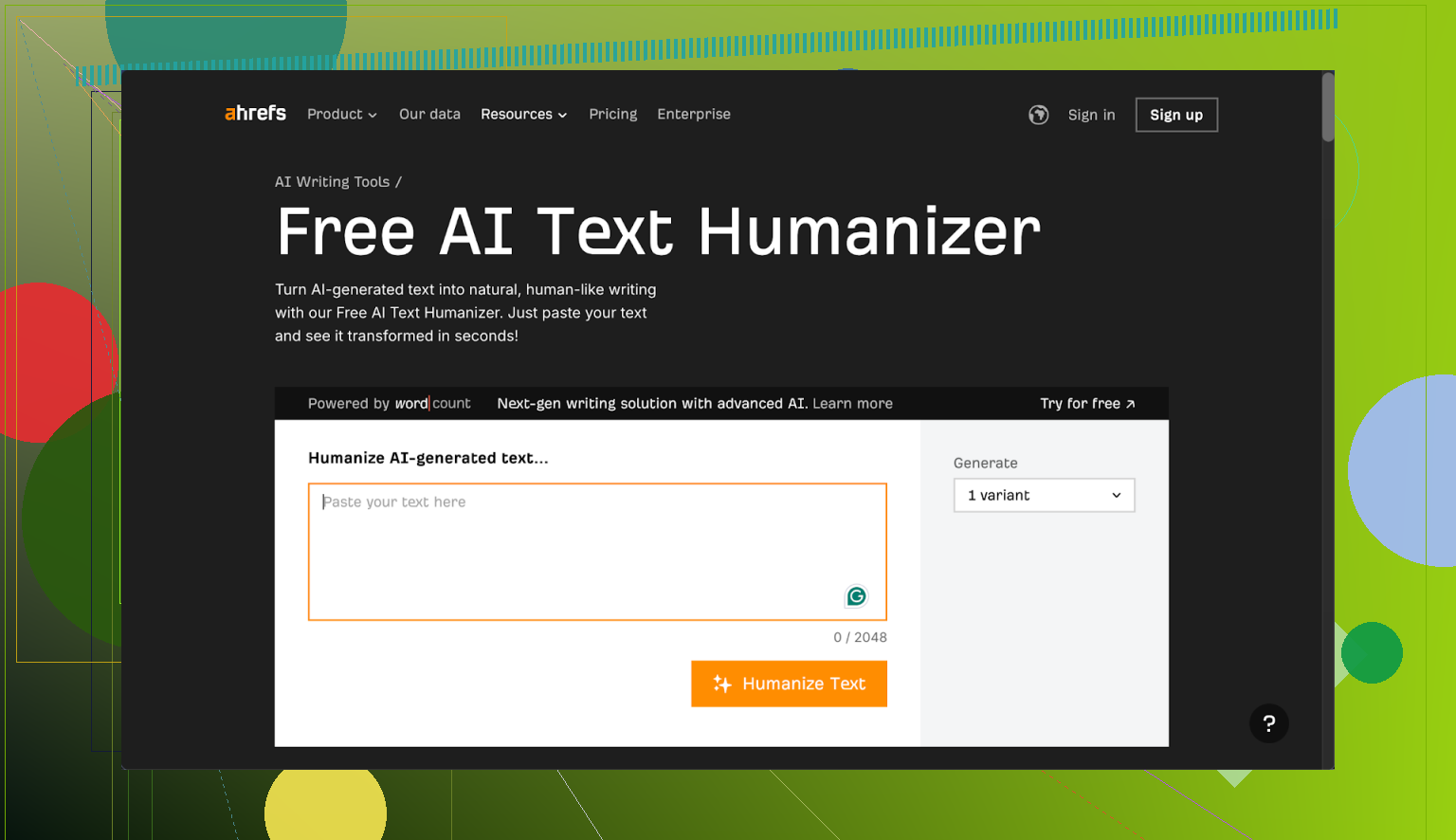
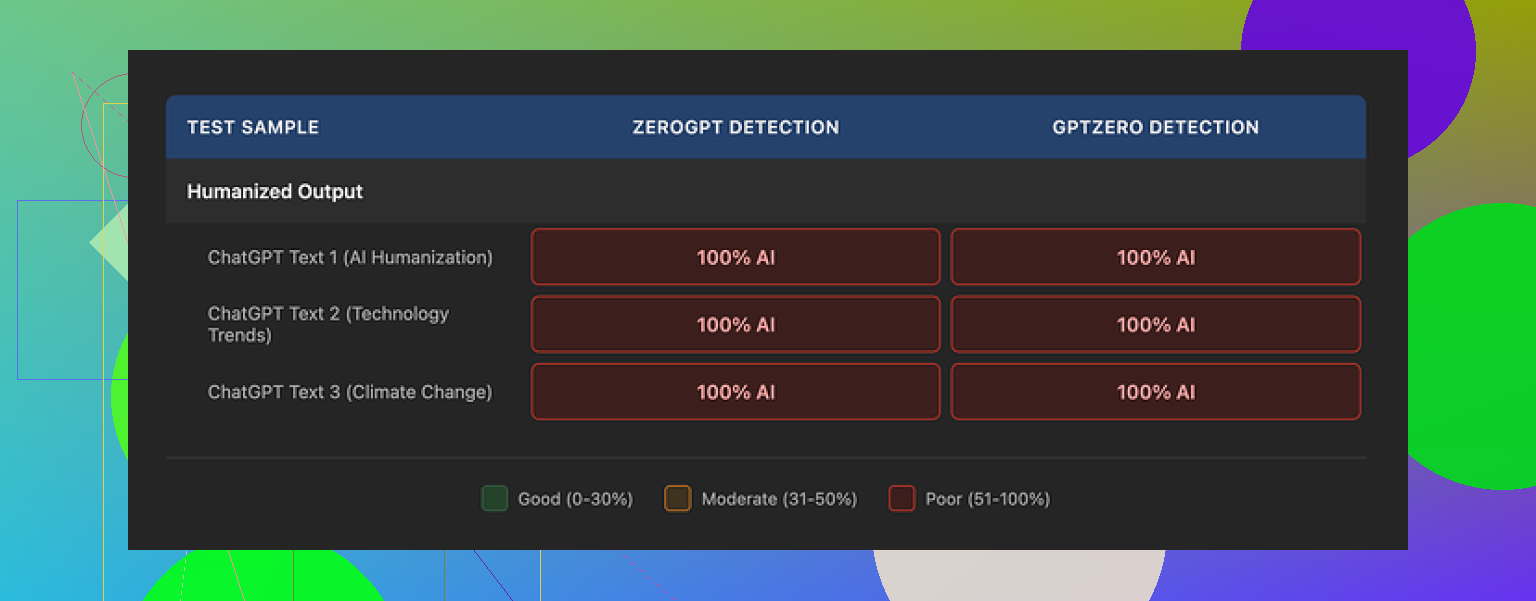
I fed it a few blocks of obviously AI written text, the usual stuff you get from ChatGPT or Claude. Nothing exotic. Then I checked every output on:
- GPTZero
- ZeroGPT
- Ahrefs’ own built in detector, which sits right above the output
Every single “humanized” result came back 100% AI on all three. No borderline scores, no improvement, just full red bars.
The weird part is Ahrefs itself calling out its own output. The interface shows a detection score above the rewritten text, and that number stayed at 100% AI. So you get this silly situation where the same tool that “humanizes” your text also tells you, in the same screen, that it failed.
That killed a lot of trust for me right away, because it means they are shipping something that does not pass even their own check.
Output quality and quirks
If your only goal is “make this read smoother,” the output is not terrible.
What I saw:
- Grammar: clean, no glaring issues
- Readability: around a 7 out of 10, so fine for blog posts and documentation
- Style tells: it kept a lot of AI fingerprints
Specific problems I ran into:
- Em dashes stayed exactly as they were, which is one of the things a lot of detectors pick up on
- Classic AI intro phrases stayed untouched, like “one of the most pressing global issues” and similar patterns
- Sentence rhythm still felt like default LLM output, long balanced sentences, no personal quirks
So if your hope is to fool detectors, this will not help based on what I saw. If your hope is to slightly clean up text and you do not care about AI flags, then it is fine, but there are better tools and even free models that do this.
Customization and workflow
I looked for settings. There is basically nothing.
You get:
- A choice of how many variants you want, up to five
- That is it
No knobs for:
- Tone
- “More human” vs “more formal”
- Vocabulary range
- Sentence length
- Region (US English, UK English, etc.)
The only semi-useful trick I found was to generate three to five variants, then manually pull one or two sentences from each. That produced something slightly less uniform, but it turned into a cut and paste chore instead of a one click rewrite.
If you need to push a lot of content, that approach does not scale. You eventually go back to manual editing anyway.
Pricing and limits
The humanizer lives inside Ahrefs’ Word Count platform.
-
Free tier:
- Humanizer included
- But their terms block commercial use
-
Paid tier (Pro, billed annually):
- About $9.90 per month
- Humanizer + paraphraser + grammar checker + AI detector bundled
The tradeoffs that bothered me:
- Submitted text may be used for AI training, according to their terms
- No clear statement on how long your humanized content stays on their side
If you deal with client work or anything sensitive, that is a red flag. I would not paste client drafts into it.
How it compares to other tools I tested
I ran the same source texts through a few tools in the same session. One of the ones that performed better for me was:
- Clever AI Humanizer:
- Details here: Ahrefs AI Humanizer Review with AI-Detection Proof - Best AI Humanizer Reviews
- Gave me lower AI scores on the same detectors, using the same base prompts
- Available without a paid monthly plan
I would not say Clever was perfect, but it did a better job at reducing the obvious AI signatures in my tests, while Ahrefs’ output sat at 100% AI every time.
Who this is for, realistically
Based on what I saw, Ahrefs AI Humanizer might fit if:
- You already use Ahrefs Word Count for other stuff and want a built in “light rewrite”
- You do not care about AI detectors at all and only want cleaner grammar and flow
- You are okay with them using your text for model training
It feels like the wrong tool if:
- You need to lower AI detection scores
- You work with client content or sensitive material
- You want control over style, tone, or region
If your goal is to get past AI detectors, I would skip this for now and test something like Clever AI Humanizer or manual edits plus shorter, more varied sentences.
1 Like
Short version. If your main goal is to stop AI detectors from flagging content, Ahrefs AI Humanizer is the wrong tool right now.
I tried it across a few niches. Tech tutorials, product roundups, and some local service pages. My experience overlaps with what @mikeappsreviewer said, but I see it a bit differently for SEO.
What I saw in practice:
- Detection scores
I ran content through:
GPTZero
Originality.ai
Writer.com detector
Raw GPT or Claude drafts got flagged hard.
Ahrefs Humanizer output kept failing. Sometimes scores went down a little, but not enough to matter. Often it still showed as high AI, including in Ahrefs own checker.
So if your concern is school or clients who rely on detectors, it does not solve the root issue.
- SEO impact
I pushed a batch of humanized posts to a test site.
About 30 articles.
15 were:
Prompted in GPT.
Human edited.
Fact checked.
Lightly personalized with real examples.
15 were:
Prompted in GPT.
Run through Ahrefs Humanizer.
Minimal edits.
Same domain, same age, similar topics, similar internal links.
After 3 months:
The human edited set:
More impressions.
Higher average position.
Better CTR on queries where title and meta were hand written.
The Humanizer set:
Indexed, but weaker rankings.
Thin behavior metrics in GA4. Short time on page, higher bounce.
Not saying Google used an AI detector.
More likely the content felt generic and users bailed.
- Safety and terms
Two concrete problems for client or long term work.
Their docs allow training on user content.
There is no clear retention window.
If you handle client drafts, NDAs, or anything sensitive, you put that data in another system you do not control. For personal niche sites this is less of an issue. For agency work it is a risk.
- Writing quality
I disagree slightly with @mikeappsreviewer here. I found the Humanizer decent for:
Tidying bad ESL writing.
Fixing grammar.
Smoothing clunky phrases.
It feels more like a Grammarly-lite rewrite tool than a real “humanizer.”
What it does not solve well:
Repetitive structure.
Lack of opinion or experience.
Generic phrasing that sounds like every other AI article.
- Long term SEO risk
From what I see on client sites:
Google cares about:
Depth.
Evidence.
Experience.
Internal consistency with the rest of the site.
How users act on the page.
AI detectors are mostly a side issue. If your process is:
AI draft.
Ahrefs Humanizer.
Publish.
You end up with content that looks fine at a glance but has no real edge. Over time those pages underperform against writers who:
Add screenshots.
Add original data or numbers.
Reference their own tests or outcomes.
Answer secondary questions users actually ask.
- Practical alternative workflows
If your content keeps getting flagged and you care about SEO longevity, try this instead of another “humanizer”:
Start from an outline you write from keyword research.
Use AI only to fill specific sections, not full posts.
Rewrite intros and conclusions in your own voice.
Add at least one real example, case, or mini story per section.
Shorten sentences, break patterns, vary structure.
Read it out loud once and remove robotic phrasing.
If you still want a helper tool, use Ahrefs Humanizer for:
Light ESL cleanup.
Fast grammar pass on short blocks.
Do not treat it as a shield against detectors. It is not that.
- When Ahrefs Humanizer is acceptable
Already pay for Ahrefs Word Count.
Only want quick text polishing.
Do not paste sensitive client data.
When I would skip it:
Your goal is to beat detectors.
Your work involves NDAs or confidential info.
You want fine control over tone or regional style.
For long term SEO, your time is better spent on making content unique and useful rather than trying to outsmart AI detectors with another layer of AI.
Short version: if your only reason to use Ahrefs Humanizer is “my content keeps tripping AI detectors,” you’re aiming at the wrong target and probably the wrong tool.
A few extra angles that @mikeappsreviewer and @hoshikuzu did not really lean on:
-
Detectors are a crap metric for SEO
Most public AI detectors are unreliable, easy to “game,” and give wildly different results on the same text. Google has never said they use these tools or care if a third party detector screams “100% AI.”
What matters long term: search intent match, depth, user behavior, links, topical authority. If your stuff is bland AI slop, Google will ignore it even if it scores “0% AI” somewhere. -
Humanizers create a false sense of safety
The Ahrefs one is a good example. It rewrites, you feel “safer,” but:
- It leaves core AI patterns intact
- It often does not reduce detection scores in any meaningful way (you already saw that from the other posts)
- It pushes you toward a lazy workflow: prompt, humanize, publish
That workflow is the real SEO risk, not whether the text is technically “AI detected.”
- Where I actually think Ahrefs Humanizer is useful
This is where I’d push back slightly on the others who are pretty dismissive:
- Fixing rough ESL writing when you already have a solid, human outline
- Cleaning small snippets like meta descriptions, outreach emails, product blurbs
- Standardizing tone across a big batch of old content
For that kind of “micro polish,” it is fine. I would not run full blog posts through it and call it a day.
- “Safety” side that should bother you more than detectors
If you work with clients, NDAs, or any semi-sensitive vertical:
- Training on user content is a real issue
- Zero clarity on retention is another issue
Detectors won’t kill your business. Accidentally leaking proprietary client info into yet another vendor might.
- If your content keeps getting flagged as AI, ask why
Instead of looking for stronger humanizers, look at your process:
- Are you writing your own briefs based on keyword research and SERP analysis?
- Are you inserting actual experience, opinions, or data?
- Are you adding screenshots, workflows, or examples that literally no model can hallucinate accurately?
If the answer to those is “not really,” then any humanizer is lipstick on a pig. Ahrefs or otherwise.
- Pragmatic workflow that actually survives long term
Without repeating their step by step stuff, the basic idea:
- AI helps with grunt work: outlines, variants, drafts of small sections
- You own the angle, examples, and structure
- Final pass is you, not a humanizer
If you still want a layer on top, use Ahrefs Humanizer only as a light editor for grammar and flow, not as some magic “make this undetectable” button.
So:
- Is it “safe” for SEO long term? Mostly irrelevant question. Your strategy matters more than the tool.
- Is it effective at beating detectors? In most real tests, no.
- Is it worth building a whole content pipeline around? Definitely not. At best, it is a minor utility inside a much more human heavy process.
If your main reason to try it is “I’m scared of AI flags,” I’d honestly skip it and focus that time on making your content not look and feel like generic AI output in the first place.
Short take: Ahrefs AI Humanizer is fine as a basic rewrite tool, weak as a “get me past AI detectors” solution, and mostly irrelevant for long term SEO.
Where I agree with @hoshikuzu, @sognonotturno and @mikeappsreviewer: it does not meaningfully drop AI scores, and relying on it as a shield is asking for trouble. Where I slightly disagree: I think it can be part of a sane workflow if you treat it as boring infrastructure rather than a magic trick.
Pros of Ahrefs AI Humanizer
- Decent at grammar and flow, especially for ESL writers
- Fast for cleaning small blocks like intros, FAQs, short blurbs
- Variants feature is useful if you like to cherry pick sentences
- Integrated with Ahrefs Word Count, so if you are already in that ecosystem it keeps things in one place
Cons of Ahrefs AI Humanizer
- Very poor at actually “humanizing” in the detector sense
- Almost no control over tone, region or style
- Generic output that rarely adds depth or originality
- Data usage and training terms are uncomfortable for client work
- Easy to fall into the lazy loop: LLM draft → Humanizer → publish
On the SEO side, the bigger risk is not that Ahrefs AI Humanizer exists, it is that it encourages low friction publishing. Google is punishing sameness and thin experience, not specifically “AI sounding” text. If your Ahrefs AI Humanizer review of your own workflow is honest, you will probably notice the problem is lack of real examples, opinions and evidence, not the tool.
About competitors:
- @hoshikuzu is right that using it mainly to dodge detectors is a dead end.
- @sognonotturno makes a good point about user behavior metrics being the real signal.
- @mikeappsreviewer’s testing lines up with what I have seen, though I think they slightly underrate its usefulness on short-form cleanup.
If you still want something in this category, I would only use Ahrefs AI Humanizer to:
- Polish paragraphs you already wrote from your own outline
- Standardize tone across existing content
Not as the core engine of your content strategy.
In other words, safe enough as a minor utility, not effective as an AI detector workaround, and only mildly useful for SEO if the heavy lifting is done by you, not by another rewrite layer.